/*
* Author: MH
* Since 2020/03/17
* Toolkit: GDB Online
*/

#include <stdio.h>

int main()
{
    int min=1;
    int max=100;
    int num;

    for(num=min; num<=max; num++)
    {
        if((num&(num-1))==0)
        {
            printf("%d is power of 2\n", num);
        }
    }

    return 0;
}
[C/C++][找出2的冪次方]
注意括弧的位置


[C/C++][pass array of character pointers]
主要是想傳遞 argv
/*
* Author: MH
* Since 2018/04/26
* Toolkit: Code::Block 16.01
*/

#include <stdio.h>
#include <stdlib.h>

int printArrayOfCharPointers (int argc, char *argv[])
{
    int i;
    for (i=0; i<argc; i++)
    {
        printf("argv[%d] %s\n", i, argv[i]);
    }
    /*
    print the following messages
    argv[0] abc123
    argv[1] mh-resource
    argv[2] ##**##
    */
    return 0;
}

int main(int argc, char *argv[])
{
    int argc_tmp = 3;
    char *argv_tmp[3];
    char p1[256];
    char p2[256];
    char p3[256];

    memcpy(p1, "abc123", sizeof("abc123"));
    argv_tmp[0] = p1;
    memcpy(p2, "mh-resource", sizeof("mh-resource"));
    argv_tmp[1] = p2;
    memcpy(p3, "##**##", sizeof("##**##"));
    argv_tmp[2] = p3;

    printArrayOfCharPointers(argc_tmp, argv_tmp);

    return 0;
}
[C/C++][實作strcmp]
/*
* Author: MH
* Since 2017/11/24
* Toolkit: Code::Block 16.01
*/

int strcmp_implementation(char *source, char *dest)
{
    while (*source!='\0' || *dest!='\0')
    {
        if (*source!=*dest)
            return -1;
        source++, dest++;
    }
    return 0;
}

int main()
{
    char *source = "abc";
    char *dest1 = "abc";
    char *dest2 = "abd";

    printf("ret1: %d\n", strcmp_implementation(source, dest1));    // return 0
    printf("ret2: %d\n", strcmp_implementation(source, dest2));    // return -1

    system("pause");
    return 0;
}
[C/C++][印出不同字體顏色與背景]
/*
* Author: MH
* Since 2014/11/11
* Toolkit: Code::Block 13.12
*/

#include <stdio.h>
#include <stdlib.h>
#include <windows.h>

int main()
{
    HANDLE hConsole = GetStdHandle(STD_OUTPUT_HANDLE);
    int colorIndex;

    for(colorIndex=0; colorIndex<255; colorIndex++)
    {
        SetConsoleTextAttribute(hConsole, colorIndex);
        printf("%3d %s\n", colorIndex, "Hello World!");
    }

    SetConsoleTextAttribute(hConsole, 15);
    system("PAUSE");
    return 0;
}
[C/C++][回傳陣列]
/*
* Author: MH
* Since 2014/09/30
* Toolkit: Code::Block 13.12
*/

#include <iostream>

using namespace std;

int *returnArray() {

    static int ra[5];

    int arrayIndex;
    for ( arrayIndex=0; arrayIndex<5; arrayIndex++ ) {
        ra[arrayIndex] = arrayIndex;
    }

    return ra;
}

int main()
{
    int *getArray = returnArray();
    int ii;

    for (ii=0; ii<5; ii++) {
        cout << *(getArray+ii) << endl;
    }

    return 0;
}
[C/C++][找出最大最小值]
在C語言中,要比較兩個數值誰大誰小應該是非常簡單的
1. 用 if 判斷式與大於、小於,這應該是最直接也是最容易想到的方法
2. 用三元運算子,其實也是一樣意思,只是看起來比較簡潔
3. bitwise 運算,這是本篇文章主要要討論的
首先我們要先知道,在 bitwise 運算下,兩數值可不必透過第三個數值做交換的動作,詳細請看以前的文章:[C/C++][不透過第三個變數做兩數值交換],既然可透過 bitwise 運算交換兩數值,那接下來就要做判斷了
在上述程式碼中,有個特別的地方,就是 -(a<b),比方說當 a=1, b=2 時,-(a<b) 就會是 -1,轉換成二進制來看的話就是全部都是 1,跟 (a^b) 做 AND operation 後還是 (a^b),套用上述的"不透過第三個變數做兩數值交換"的結果可知,(b^((a^b) & (-(a<b)))) = (b^(a^b)) = a;那如果 a=2, b=1 時,-(a<b) 就會是 0,跟 (a^b) 做 AND operation 後還是 0,(b^((a^b) & (-(a<b)))) = (b^0) = b,即是找出較小的值
那如果要找最大值呢?很簡單,只要改最前面的 b 就好了,如下
1. 用 if 判斷式與大於、小於,這應該是最直接也是最容易想到的方法
2. 用三元運算子,其實也是一樣意思,只是看起來比較簡潔
(a<b)?a:b
3. bitwise 運算,這是本篇文章主要要討論的
首先我們要先知道,在 bitwise 運算下,兩數值可不必透過第三個數值做交換的動作,詳細請看以前的文章:[C/C++][不透過第三個變數做兩數值交換],既然可透過 bitwise 運算交換兩數值,那接下來就要做判斷了
#include <iostream>

using namespace std;

int main () {

    int a = 1;
    int b = 2;

    cout << (b^((a^b) & (-(a<b)))) << endl;    // min(a, b)

    return 0;
}
在上述程式碼中,有個特別的地方,就是 -(a<b),比方說當 a=1, b=2 時,-(a<b) 就會是 -1,轉換成二進制來看的話就是全部都是 1,跟 (a^b) 做 AND operation 後還是 (a^b),套用上述的"不透過第三個變數做兩數值交換"的結果可知,(b^((a^b) & (-(a<b)))) = (b^(a^b)) = a;那如果 a=2, b=1 時,-(a<b) 就會是 0,跟 (a^b) 做 AND operation 後還是 0,(b^((a^b) & (-(a<b)))) = (b^0) = b,即是找出較小的值
那如果要找最大值呢?很簡單,只要改最前面的 b 就好了,如下
#include <iostream>

using namespace std;

int main () {

    int a = 1;
    int b = 2;

    cout << (a^((a^b) & (-(a<b)))) << endl;    // max(a, b)

    return 0;
}
[C/C++][strlen實作]
/*
* Author: MH
* Since 2013/10/29
* Toolkit: Code::Block 12.11
*/

#include <stdio.h>

int strlen_implementaion (const char *str) {
    int countStr = 0;
    while (*(str+countStr)!='\0')
            countStr++;
    return countStr;
}

int main () {
    char *str = "abcde";
    printf("%d", strlen_implementaion(str));    // 5
    return 0;
}
[C/C++][實作strcpy與strncpy]
/*
* Author: MH
* Since 2013/10/28
* Toolkit: Code::Block 12.11
*/

#include <stdio.h>

char *strcpy_implementation(char *strDst, const char *strSrc) {

    char *newStr = NULL;
    int strCount = 0;

    if ((strDst==NULL) || (strSrc==NULL)) {
        return NULL;
    }

    newStr = strDst;
    while (*(strSrc+strCount)!='\0') {
        *newStr = *(strSrc+strCount);
        newStr++;
        strCount++;
    }
    *newStr = '\0';

    return strDst;
}

int main () {

    char *str1 = "Sample string";
    char str2[20];

    strcpy_implementation (str2, str1);
    printf ("str1: %s\n", str1);
    printf ("str2: %s\n", str2);    // str2: Sample string

    return 0;
}
網路上還有看到比較簡潔的寫法
/*
* Author: MH
* Since 2013/10/28
* Toolkit: Code::Block 12.11
*/

#include <stdio.h>

void strcpy_implementation2 (char x[], char y[]) {
    int i = 0;
    while ((x[i]=y[i])!='\0') {
        i+=1;
    }
}

int main () {

    char *str1 = "Sample string";
    char str2[20];

    strcpy_implementation2 (str2, str1);
    printf ("str1: %s\n", str1);
    printf ("str2: %s\n", str2);    // str2: Sample string

    return 0;
}
/*
* Author: MH
* Since 2013/10/28
* Toolkit: Code::Block 12.11
*/

#include <stdio.h>

char *strncpy_implementation(char *strDst, const char *strSrc, int strLength) {

    char *newStr = NULL;
    int strCount = 0;

    if ((strDst==NULL) || (strSrc==NULL)) {
        return NULL;
    }

    newStr = strDst;
    while ((*(strSrc+strCount)!='\0') && (strCount<strLength)) {
        *newStr = *(strSrc+strCount);
        newStr++;
        strCount++;
    }
    *newStr = '\0';

    return strDst;
}

int main () {

    char *str1 = "Sample string";
    char str2[20];

    strncpy_implementation (str2, str1, 4);
    printf ("str1: %s\n", str1);
    printf ("str2: %s\n", str2);    // str2: Samp

    return 0;
}
[C/C++][傳遞與回傳字串]
/*
* Author: MH
* Since 2013/10/21
* Toolkit: Code::Block 12.11
*/

#include <stdio.h>

void returnString(char **str2)
{
    printf("before: %s\n", *str2);    // before: abc
    *str2 = "def";
    printf("after: %s\n", *str2);    // before: def
}

int main()
{
    char *str1 = "abc";

    printf("before returnString: %s\n", str1);    // before returnString: abc
    returnString(&str1);
    printf("after returnString: %s\n", str1);    // before returnString: def

    return 0;
}
[C/C++][不同欄位的動態二維陣列]
要特別注意的是 p 的產生方法,最後 deallocate 可簡單的用剛好可 deallocate 最大 column 數即可,當然也可依每個 row 的不同 column 去 deallocate
/*
* Author: MH
* Since 2013/10/21
* Toolkit: Code::Block 12.11
*/

#include <iostream>

using namespace std;

int main() {
    int i, r=3;

    // generate rows
    int **p = new int *[r];

    // generate columns
    p[0] = new int[1];    // columns for the 1st row
    p[1] = new int[2];    // columns for the 2nd row
    p[2] = new int[3];    // columns for the 3rd row

    // assign values
    p[0][0] = 1;
    p[1][0] = 2;    p[1][1] = 2;
    p[2][0] = 3;    p[2][1] = 3;    p[2][2] = 3;

    // output the value
    cout << p[0][0] << endl;
    cout << p[1][0] << " " << p[1][1] << endl;
    cout << p[2][0] << " "<< p[2][1] << " "<< p[2][2] << endl;

    // deallocate
    for (i=0; i<r; i++) {
        delete []p[i];    // delete columns
    }
    delete []p;

    return 0;

}
[C/C++][Structure Pointer]
對變數 student 其中的成員取用為 s.name
若用指標方法存取 student *ps,則必須使用箭頭 ps->name
若用指標方法存取 student *ps,則必須使用箭頭 ps->name
/*
* File Name: StructurePointer.cpp
* Author: MH
* Since 2013/04/01
* Toolkit: Dev C++ 4.9.9.9
*/

#include <stdio.h>

struct student{

    char name[4];
    int id;
    float gpa;

};

int main(){

    struct student s = {"Sam", 9732, 3.5};
    struct student *ps = &s;
    // ps: a pointer pointing to structure variable s

    struct student &rs = s;
    // rs: a reference variable, it is an alias of s

    printf("%s %d %f\n", s.name, s.id, s.gpa);
    printf("%s %d %f\n", ps->name, ps->id, ps->gpa);
    printf("%s %d %f\n", rs.name, rs.id, rs.gpa);

    return 0;
}
[C/C++][別名]
/*
* File Name: AliasUsingDereference.c
* Author: MH
* Since 2013/04/01
* Toolkit: Dev C++ 4.9.9.9
*/

#include <stdio.h>

int main(){

    int x = 5;
    int *p;

    p = &x;
    printf("*p = %d\n", *p);

    *p = 6;
    printf("x = %d", x);

    return 0;
}
/*
* File Name: AliasUsingReference.c
* Author: MH
* Since 2013/04/01
* Toolkit: Dev C++ 4.9.9.9
*/

#include <stdio.h>

int main(){

    int a = 5;
    int &b = a;

    printf("b = %d\n", b);

    b = 6;
    printf("a = %d", a);

    return 0;
}
[C/C++][傳遞字串]
簡單的範例
/*
* File Name: StringAsParameters.c
* Author: MH
* Since 2013/03/25
* Toolkit: Dev C++ 4.9.9.9
*/

#include <stdio.h>

int main(){

    void change(char *);
    char s[] = "abcdefg";
    char t[] = "ijklmnop";

    change(s);
    change(t);

    puts(s);    // ab$de+g
    puts(t);    // ij$lm+op

    return 0;
}

void change(char *x){

    *(x+2) = '$';    // x[2]='$';
    *(x+5) = '+';    // x[5]='+';
}
[C/C++][幻方]
幻方,有時又稱魔方,可參考動畫圖

Source:http://en.wikipedia.org/wiki/File:SiameseMethod.gif
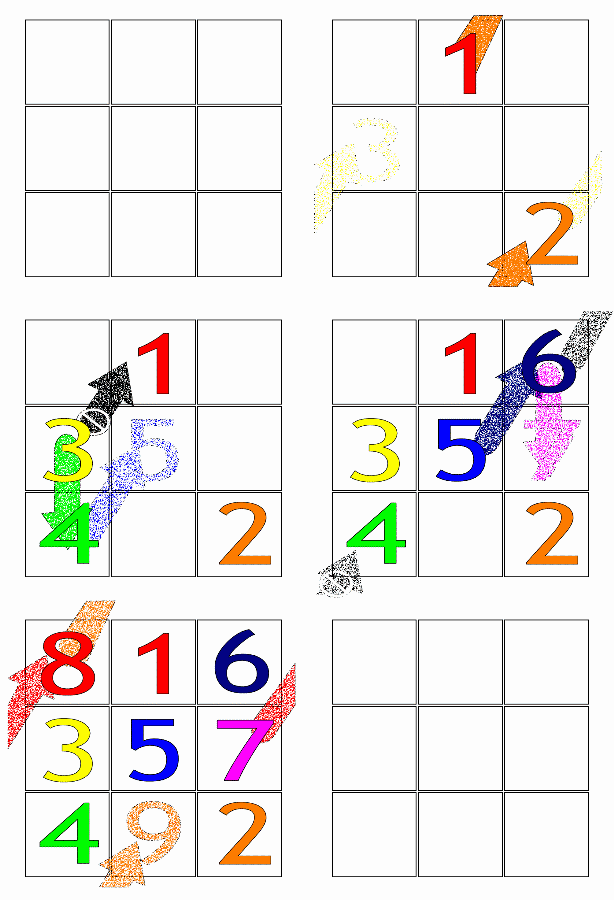
Source:http://en.wikipedia.org/wiki/File:SiameseMethod.gif

/*
* File Name: MagicSquare.c
* Author: MH
* Since 2013/03/10
* Toolkit: Dev C++ 4.9.9.9
*/

#include <stdio.h>
#define max_n 20

int main(){

    int x[max_n][max_n];
    int i, j, k, n;

    do{
        printf("Enter odd array size (3~19): ");
        scanf("%d", &n);
    }while((n>19) || (!(n%2)) || (n<3));

    // fill zero into array
    for (i=0; i<n; i++)
        for (j=0; j<n; j++)
            x[i][j] = 0;

    // by placing a 1 in the middle location of top row
    i = 0;
    j = (n-1)/2;    // find the central position
    x[i][j] = 1;

    for (k=2; k<=n*n; k++){

        // write successive integers in an upward-right diagonal path;
        i--;
        j++;

        // if the row and column indices all out of bound
        // the next location will be at the second row
        // the (n-1)th column
        if ((i<0) && j>n-1){
            i = 1;    // second row
            j = n-1;    // (n-1)the column
        }

        // if the row index out of bound (i<0)
        // use the maximum row index
        else if (i<0)
            i = n-1;

        // if the column index out of bound (j>n-1)
        // use the minimum column index
        else if (j>(n-1))
            j = 0;

        if (x[i][j]!=0){
            i += 2;
            j--;
        }
        x[i][j] = k;

    }

    for (i=0; i<n; i++){
        for (j=0; j<n; j++){
            printf("%4d", x[i][j]);
        }
        printf("\n");
    }

    return 0;
}
[C/C++][動態二維陣列的使用]
/*
* File Name: Dynamic2DimentionalArray.cpp
* Author: MH
* Since 2013/03/03
* Toolkit: Dev C++ 4.9.9.9
*/

#include <iostream>

using namespace std;

int main(){

    int r, c, **p, i, j;

    cout << "enter the row: ";
    cin >> r;
    cout << "enter the column: ";
    cin >> c;
    cout << endl;

    p = new int *[r];    // generating rows
    for (i=0; i<r; i++)    // generating columns
        p[i] = new int[c];    // Not new int *[c]!!

    for (i=0; i<r; i++)    // accessing: assigning values
        for (j=0; j<c; j++)
            p[i][j] = i;

    for (i=0; i<r; i++){    // accessing: printing values
        for (j=0; j<c; j++)
            cout << p[i][j] << " ";
        cout << endl;
    }

    for (i=0; i<r; i++)    // deallocate the memory
        delete []p[i];    // delete columns
    delete []p;

    return 0;
}
[C/C++][動態一維陣列的使用]
/*
* File Name: Dynamic1DimentionalArray.cpp
* Author: MH
* Since 2013/03/03
* Toolkit: Dev C++ 4.9.9.9
*/

#include <iostream>

using namespace std;

int main(){

    int size, i, *q;

    cout << "enter the size: ";
    cin >> size;

    q = new int [size];    // generating

    for (i=0; i<size; i++)    // accessing: assigning values
        q[i] = i;
    for (i=0; i<size; i++)    // accessing: printing values
        cout << q[i] << " ";

    // deallocate the memory when no longer needed
    delete []q;

    return 0;
}
[C/C++][動態變數的使用]
/*
* File Name: DynamicVariable.cpp
* Author: MH
* Since 2013/03/03
* Toolkit: Dev C++ 4.9.9.9
*/

#include <iostream>

using namespace std;

int main(){

    int *s;

    s = new int;
    cout << "intput int *s " << endl;
    cin >> *s;    // generating
    cout << "*s = " << *s << endl;

    // deallocate the memory when no longer needed
    delete s;

    return 0;
}
[C/C++][Bubble Sort]
/*
* File Name: BubbleSort.c
* Author: MH
* Since 2013/02/22
* Toolkit: Dev C++ 4.9.9.9
*/

#include <stdio.h>
#include <stdlib.h>

void swap (int *a, int *b){

    int tmp;

    tmp = *a;
    *a = *b;
    *b = tmp;
}

int main(int argc, char *argv[]){

    int i, j, n=5;
    int list[5] = {10, 7, 19, 5, 6};

    printf("Before Bubble Sort\n");

    for (i=0; i<n; i++)
        printf("list[%d] = %d\n", i, list[i]);

    for (i=0; i<n-1; i++)
        for (j=0; j<n-i-1; j++)
            if (list[j]>list[j+1])
                swap(&list[j], &list[j+1]);

    printf("\nAfter Bubble Sort\n");

    for (i=0; i<n; i++)
        printf("list[%d] = %d\n", i, list[i]);

    system("PAUSE");
    return 0;
}
[C/C++][Selection Sort]
/*
* File Name: SelectionSort.c
* Author: MH
* Since 2013/02/22
* Toolkit: Dev C++ 4.9.9.9
*/

#include <stdio.h>
#include <stdlib.h>

void swap (int *a, int *b){

    int tmp;

    tmp = *a;
    *a = *b;
    *b = tmp;
}

int main(int argc, char *argv[]){

    int i, j, n=5;
    int list[5] = {10, 7, 19, 5, 6};

    printf("Before Slelction Sort\n");

    for (i=0; i<n; i++)
        printf("list[%d] = %d\n", i, list[i]);

    for (i=0; i<n; i++)
        for (j=i+1; j<n; j++)
            if (list[i]>list[j])
                swap(&list[i], &list[j]);

    printf("\nAfter Slelction Sort\n");

    for (i=0; i<n; i++)
        printf("list[%d] = %d\n", i, list[i]);

    system("PAUSE");
    return 0;
}
[C/C++][實作memset、memcpy與memcmp]
memset請參考:http://www.cplusplus.com/reference/cstring/memset/
memcpy請參考:http://www.cplusplus.com/reference/cstring/memcpy/
memcmp請參考:http://www.cplusplus.com/reference/cstring/memcmp/
void *memset(void *s, char c, unsigned long n){

    unsigned long i;
    char *ss = (char *)s;

    for (i=0; i<n; i++)
        ss[i] = (char)c;

    return s;
}
memcpy請參考:http://www.cplusplus.com/reference/cstring/memcpy/
void *memcpy(void *dest, const void *src, unsigned long count){

    char *tmp = dest;
    const char *s = src;

    while (count--)
        *tmp++ = *s++;

    return dest;
}
memcmp請參考:http://www.cplusplus.com/reference/cstring/memcmp/
int memcmp(const void *cs, const void *ct, unsigned long count){

    const unsigned char *su1, *su2;
    int res = 0;

    for (su1=cs, su2=ct; 0<count; ++su1, ++su2, count--)
        if ((res = *su1 - *su2) != 0)
            break;

    return res;
}
訂閱:
意見 (Atom)